The 2026 Code Shift: How to Optimize Your Tech Stack for AI Search Engines (GEO)
Table of Contents
- Why AI Search Changes the Developer's Playbook
- What Generative Engine Optimization (GEO) Actually Means
- Step-by-Step Code Blueprint for AI Optimization
- The Core Metrics AI Scrapers Look For
- Topical Authority: How to Signal It Technically
- Common Mistakes That Kill AI Visibility
- GEO Checklist for Development Teams
- FAQ
If your website isn't showing up inside ChatGPT, Claude, Perplexity, or Google's AI Overviews, you are rapidly losing visibility — and likely revenue.
We are officially living in the era of Generative Engine Optimization (GEO). Traditional keyword stuffing is dead. According to a 2026 BrightEdge study, over 68% of online searches now begin with an AI engine rather than a traditional search bar. A massive and growing portion of web traffic originates from users typing complex, natural-language questions directly into AI windows instead of clicking standard blue search links.
To win these impressions, your software architecture and code structure must be readable not just by human eyes, but by LLM (Large Language Model) crawlers. Here is how to audit and optimize your codebase to become an authoritative source for AI engines.
1. Why AI Search Changes the Developer's Playbook
Traditional search engines primarily look for keyword matching, backlink velocity, page speed, and Core Web Vitals scores. While those signals still matter for baseline health, AI search engines crawl websites looking for something entirely different: Topical Authority, Context Density, and Verifiable Proof.
When a user asks Perplexity or Claude to "Find the best custom ERP integration framework for a mid-sized e-commerce platform," the AI doesn't pull up a random page with that title. It scans the web for:
- Clean, structurally sound data models — pages where the hierarchy of information is immediately obvious
- Clear, jargon-free documentation — explanations that can be extracted and paraphrased
- Direct, verifiable answers — facts, numbers, steps, and comparisons it can synthesize into a coherent response
- Entity relationships — who wrote it, what organization published it, and what credentials back the claims
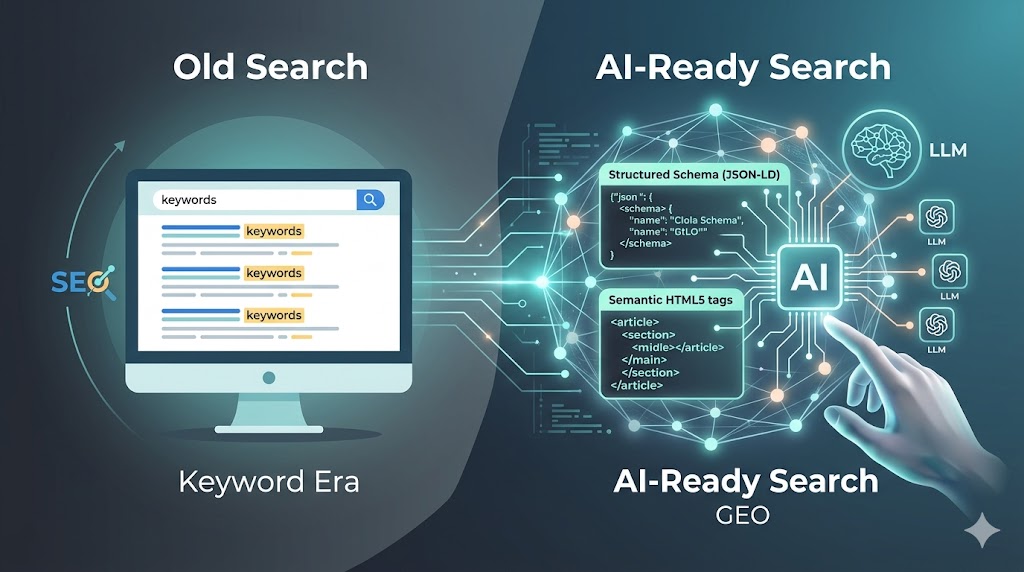
The fundamental shift is this: traditional SEO optimizes for a crawler that reads keywords. GEO optimizes for a model that understands meaning. Your job as a developer is to make your website's meaning unmistakably clear from the HTML structure itself.
2. What Generative Engine Optimization (GEO) Actually Means
GEO is the practice of structuring your web content, technical architecture, and semantic markup so that AI language models can accurately extract, understand, and cite your content as an authoritative answer.
According to research published by Princeton, Georgia Tech, and Allen AI (2024), adding statistics, citations, and structured quotations to web content increased citation frequency in AI-generated responses by up to 40%. That is a measurable, reproducible effect.
GEO is not a replacement for traditional SEO. It is an additional optimization layer that sits on top of a healthy technical SEO foundation. You still need:
- Fast page load times (LCP under 2.5s)
- Mobile responsiveness
- HTTPS and clean crawlability
- Quality backlinks from authoritative domains
What GEO adds on top of this is the signal layer — explicit structural, semantic, and schema-based signals that tell an AI model exactly who you are, what you know, and why you are trustworthy.
3. Step-by-Step Code Blueprint for AI Optimization
To ensure an AI crawler chooses your page as its primary citation, you need to transition your frontend architecture from visual-first to structure-first. Here is the technical roadmap.
Step 1: Adopt Strict Semantic HTML — The Foundation
Ditch "div soup." AI engines rely heavily on native HTML landmark elements to map out the hierarchy of your content. Use <article>, <section>, <aside>, <nav>, <header>, and <footer> with intentionality. Each tag is a semantic instruction to the parser.
Step 2: Inject Deep JSON-LD Schema Markup — The Context Layer
Do not stop at standard WebPage schema. Deploy highly specific schemas like TechArticle, FAQPage, and Service markup. Explicitly state variables like author, publisher, and knowsAbout to hand-feed your entity relationships directly to the crawler.
Step 3: Format Data with Tables, Lists, and Clear Headers — The Extraction Layer
LLMs are trained on structured summaries. Whenever you are contrasting technical specifications, pricing models, or feature comparisons, present them in a clean table or a labeled list positioned directly below an explicit heading. This makes it easy for AI to scrape and display your data inside a chat response.
Step 4: Maximize Server-Side Rendering (SSR) — The Performance Layer
Heavy client-side JavaScript applications require full browser hydration before text is visible. AI scrapers routinely skip dynamically rendered content if it isn't present on the initial server response. Use SSR (Next.js, Nuxt.js, Remix) or static site generation to ensure your text content is fully present in the raw HTML response.
Step 5: Build a Dedicated Q&A and FAQ Architecture
AI models are optimized to answer questions. Pages that explicitly structure content as question-answer pairs are significantly more likely to be cited. Implement FAQPage schema and dedicate a section of every article to 4–6 direct questions with direct answers.
4. The Core Metrics AI Scrapers Look For
| Metric | What It Means | How to Optimize It |
|---|---|---|
| Information Density | Ratio of useful facts to filler text | Keep paragraphs under 3 sentences. Lead with the answer, then elaborate. |
| Entity Clarity | How clearly the page identifies its author, publisher, and topic | Use JSON-LD with full author, publisher, and about fields |
| Structural Coherence | Whether heading hierarchy matches the actual content flow | Audit your heading structure — no skipped levels, no decorative headings |
| Citation Credibility | Whether claims are backed by named sources or data | Link externally to credible research; cite statistics with source names |
| Freshness Signal | How recently the content was updated | Add dateModified to schema; review and update articles at least annually |
| Answer Completeness | Whether a single page can fully answer its target query | Cover the topic end-to-end — include examples, caveats, and alternatives |
5. Topical Authority: How to Signal It Technically
Single well-written articles do not win AI citations. Topical clusters do. An AI model learns that your website is authoritative on a subject when it sees a dense, interconnected web of content all pointing to and from a central pillar page.
Build your site architecture as follows:
- Pillar Page: A comprehensive 3,000+ word guide on your core topic
- Cluster Pages: 8–12 supporting articles that each go deep on one sub-topic
- Internal Links: Every cluster page links back to the pillar and to 2–3 other cluster pages
- Consistent Entity Mentions: The same author names, company name, and service names appear across all pages, creating a consistent entity graph that AI models can recognize
6. Common Mistakes That Kill AI Visibility
- Publishing thin content under 1,000 words. AI models prefer comprehensive answers. A 600-word article on a complex technical topic signals that your content is surface-level.
- Using anonymous or fake author names. "By Admin" or "By Staff Writer" provides no credibility signal. Every article must have a named, credentialed author with a profile page.
- Hiding content in JavaScript components. If your content is only visible after a React hydration cycle, many AI scrapers will never see it. Keep body text in server-rendered HTML.
- Writing for keywords instead of questions. GEO targets the underlying question behind the keyword, not just the keyword phrase itself.
- Ignoring Core Web Vitals. Slow pages are crawled less frequently by Googlebot, which reduces how often AI systems can index your fresh content.
7. GEO Checklist for Development Teams
- Page uses semantic HTML5 landmark elements (article, section, aside)
- JSON-LD TechArticle or BlogPosting schema is present with full author and publisher fields
- FAQPage schema is present with at least 4 questions
- Page content is visible in raw HTML (no JS-only rendering)
- H1 → H2 → H3 heading hierarchy is logical and sequential
- At least one data table or structured list is present
- All factual claims link to external, named sources
- Author has a linked profile page with credentials
- Article word count exceeds 1,500 words
- At least 3 internal links to related content on the same domain
- Open Graph and Twitter Card meta tags are complete
FAQ
What is the difference between SEO and GEO?
Traditional SEO optimizes content for search engine crawlers that rank pages by keyword relevance and backlinks. GEO (Generative Engine Optimization) optimizes content for AI language models that extract and synthesize answers from web pages. GEO focuses on semantic structure, entity clarity, and answer completeness rather than keyword density.
Do I need to rewrite my entire website for GEO?
No. Start with your highest-traffic pages and most valuable service pages. Add schema markup, improve heading structure, and add FAQ sections. These changes can be made incrementally without a full site rebuild.
Which AI engines should I optimize for?
Focus primarily on Google's AI Overviews, Perplexity, and ChatGPT browsing mode. These three currently drive the largest share of AI-sourced web traffic.
How long does it take to see results from GEO changes?
Most practitioners report seeing changes in AI citation frequency within 4–8 weeks of implementing schema markup and structural improvements. This is faster than traditional backlink-based SEO, which can take 3–6 months.
Is server-side rendering mandatory for GEO?
It is strongly recommended. If full SSR is not feasible, ensure that at minimum your article body content is rendered server-side or via static generation. Client-rendered content will be missed by a significant percentage of AI crawlers.
Does page speed affect GEO rankings?
Yes. Slow pages are crawled less frequently by Googlebot, which means AI systems see your content less often. Maintain LCP under 2.5 seconds and INP under 200ms as a baseline.
Ready to Optimize Your Website for AI Search?
XCodeSol specializes in building technically precise, AI-ready web architectures for businesses that want to grow their visibility across both traditional and generative search engines.
Explore our SEO and Digital Marketing Services or talk to our team on WhatsApp.